
You're growing in this Zip Code:
Change LocationDiscover Plants for Your Area
Columnar Swedish Aspen
Populus tremula 'Erecta'
Pronunciation: POP-yoo-lus TREM-yoo-luh ee-RECK-tuh
SKU #01831
LIGHT:
Full sun
WATER:
Water when top 2 inches of soil is dry.
SIZE:
Moderate growing; reaches 40 ft. tall, 10 ft. wide.

Retailers Near You
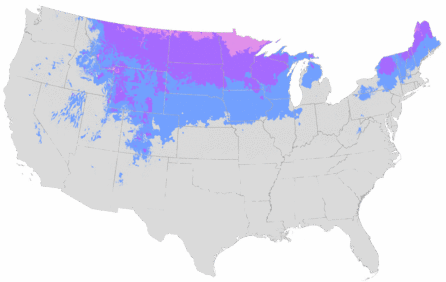
| Description | Flat, rounded green leaves flutter and rustle in the breeze providing both visual interest and soothing sound to the landscape. Very narrow form is great for small spaces, as a tall screen, and for lining a drive. Well-adapted to very cold climates. Deciduous. |
|---|---|
| Bloom Time | Inconspicuous; prized for foliage. |
| Deciduous/Evergreen | Deciduous |
| Problems/Solutions | Road Salt Tolerant |
| Growth Rate | Moderate |
| Landscape Use | Privacy Screen, Windbreak |
| Design Ideas | This is a superior tree for cold northern regions. It is most attractive in groves, and as components in windrows and shelterbelts. It will stand alone as a columnar tree in the suburban environment. Tall narrow form is ideal for filling gaps between tall buildings. Somewhat adapted for street and boulevard planting. A great foreground tree against dark background of evergreen conifers. Ease of cultivation is suited to naturalistic plantings in prairies or open space habitat. |
| Foliage Color | Green |
| Companion Plants | Blue Spruce (Picea pungens); Anemone (Anemone hybrids); Yew (Taxus); Snowberry (Symphoricarpos); Sumac (Rhus aromatica); Currant (Ribes) |
| Care Instructions | Provide enriched, well-drained soil. Best planted on north or east facing sites; avoid hot and dry exposures. Water deeply, regularly during the first growing season to establish an extensive root system. Feed with a general purpose fertilizer before new growth begins in spring. |
| History | Genus Populus can be divided into poplars, aspens and cottonwoods which can be found in the Northern Hemisphere. The genus is named for its very ancient name as the "people's tree" because they are so easily propagated. Chief values have been as a forestry source of pulpwood and some furniture wood. In agricultural regions it has long been favored for windbreak and shelterbelt planting due to its tolerance of high density plantings. This species is native to Europe with 'Erecta' considered one of the best columnar forms. |
Details
| Description | Flat, rounded green leaves flutter and rustle in the breeze providing both visual interest and soothing sound to the landscape. Very narrow form is great for small spaces, as a tall screen, and for lining a drive. Well-adapted to very cold climates. Deciduous. |
|---|---|
| Bloom Time | Inconspicuous; prized for foliage. |
| Deciduous/Evergreen | Deciduous |
| Problems/Solutions | Road Salt Tolerant |
| Growth Rate | Moderate |
Style
| Landscape Use | Privacy Screen, Windbreak |
|---|---|
| Design Ideas | This is a superior tree for cold northern regions. It is most attractive in groves, and as components in windrows and shelterbelts. It will stand alone as a columnar tree in the suburban environment. Tall narrow form is ideal for filling gaps between tall buildings. Somewhat adapted for street and boulevard planting. A great foreground tree against dark background of evergreen conifers. Ease of cultivation is suited to naturalistic plantings in prairies or open space habitat. |
| Foliage Color | Green |
| Companion Plants | Blue Spruce (Picea pungens); Anemone (Anemone hybrids); Yew (Taxus); Snowberry (Symphoricarpos); Sumac (Rhus aromatica); Currant (Ribes) |
Care
| Care Instructions | Provide enriched, well-drained soil. Best planted on north or east facing sites; avoid hot and dry exposures. Water deeply, regularly during the first growing season to establish an extensive root system. Feed with a general purpose fertilizer before new growth begins in spring. |
|---|
History
| History | Genus Populus can be divided into poplars, aspens and cottonwoods which can be found in the Northern Hemisphere. The genus is named for its very ancient name as the "people's tree" because they are so easily propagated. Chief values have been as a forestry source of pulpwood and some furniture wood. In agricultural regions it has long been favored for windbreak and shelterbelt planting due to its tolerance of high density plantings. This species is native to Europe with 'Erecta' considered one of the best columnar forms. |
|---|
Retailers Near You
About Us
We have been pioneers and craftsmen in the art of growing plants for 100 years. Since our founding in Southern California by Harry E. Rosedale, Sr. in 1926, we have been absolutely dedicated and obsessed with quality.
We have been pioneers and craftsmen in the art of growing plants for nearly 100 years. Since our founding in Southern California by Harry E. Rosedale, Sr. in 1926, we have been absolutely dedicated and obsessed with quality.