
You're growing in this Zip Code:
Change LocationDiscover Plants for Your Area
Crimson Curls Heuchera
Heuchera x 'Crimson Curls'
Pronunciation: HEW-ker-a
SKU #04078
LIGHT:
Full sun, Partial sun
WATER:
Water when top 2 inches of soil is dry.
SIZE:
Moderate growing to 12 to 18 in. tall and wide.

Retailers Near You
| Description | Deep crimson foliage has distinctive curly edges creating a compact, uniform mound. A vivid foliage accent set against green and gray foliage in woodlands and perennial borders. |
|---|---|
| Bloom Time | Summer |
| Deciduous/Evergreen | Herbaceous |
| Special Features | Attracts Hummingbirds, Dramatic Foliage Color, Non-toxic to Cats and Dogs, Attracts Pollinators, Compact Form |
| Problems/Solutions | Deer Resistant |
| Growth Rate | Moderate |
| Growth Habit | Clumping |
| Flower Attributes | Flowers for Cutting, Showy Flowers |
| Patent Act | Asexual reproduction of plants protected by the Plant Patent Act is prohibited during the life of the patent. |
| Landscape Use | Border |
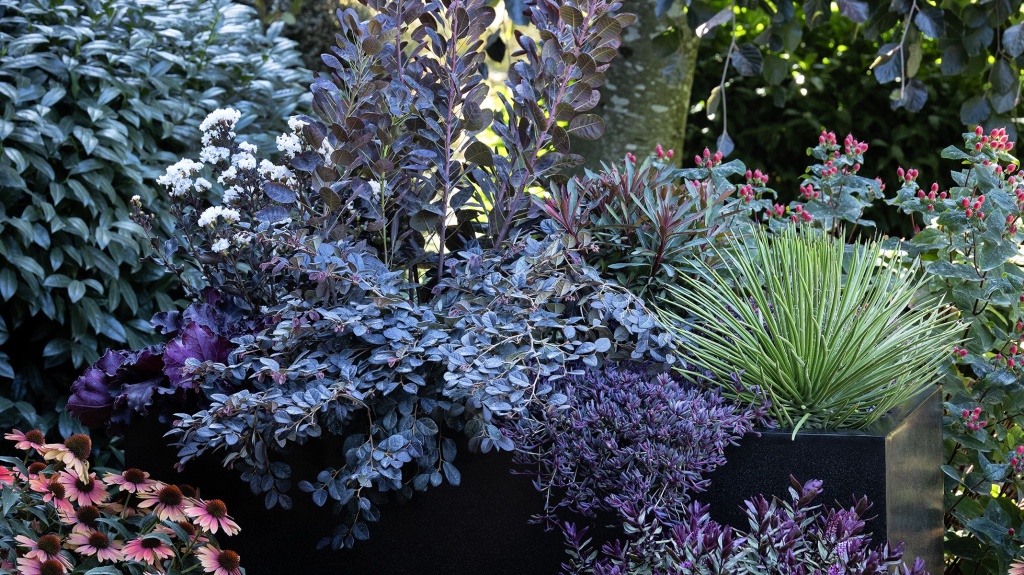
| Design Ideas | This high contrast purple red foliage is exceptional for shaded mixed borders that tend to be all too green in color. Use in small irregular groups for the woodland garden or naturalistic settings. In more formal settings use as a mass focal point or as linear edging. It is excellent in front where plants are viewed up close for both foliage and flowers. Good plant for nestling landscape boulders or to round the base of pedestal or fountain. Excellent candidate for pots and troughs, even north facing window boxes as foliage accent or delicate flower spikes. |
| Flower Color | White |
| Foliage Color | Red |
| Companion Plants | Group this heuchera with Orange Meadowbrite Coneflower, (Echinacea 'Art's Pride'), Golden Zebra Daylily, (Hemerocallis x 'Malja') and Astilbe Color Flash Lime, (Astilbe x arendsii 'Beauty of Lisse'). Create a color foliage bed with others of its kind with Marmalade Coral Bells, (Heuchera x 'Marmalade'), Lime Rickey Coral Bells, (Heuchera x 'Lime Rickey') and metallic Silver Scrolls Coral Bells, (Heuchera x 'Silver Scrolls') |
| Care Instructions | Follow a regular watering schedule during the first growing season to establish a deep, extensive root system. Provide part shade in hot summer climates. For a neat appearance, remove old foliage before new leaves emerge. Divide clumps every 2 to 3 years in early spring. |
| History | About fifty species of Heuchera are native to North America but only a few are in cultivation. This hybrid is related to three different species which contribute strong purple coloring to the foliage. H. sanguinea is the common coral bell of the Southwest. It is often crossed with H.americana of the eastern U.S. and H. micrantha, a native to the west. Many of the early hybrids of these crosses were grouped under H. x brizoides. The genus name honors European botanist Johan Heinrich von Heuchera, who first identified the wildflowers in 1730. |
| Lore | Native Americans used these thick roots for a medicinal by drying and then pounding them into a wound dressing, hence the common name, alum root. |
Details
| Description | Deep crimson foliage has distinctive curly edges creating a compact, uniform mound. A vivid foliage accent set against green and gray foliage in woodlands and perennial borders. |
|---|---|
| Bloom Time | Summer |
| Deciduous/Evergreen | Herbaceous |
| Special Features | Attracts Hummingbirds, Dramatic Foliage Color, Non-toxic to Cats and Dogs, Attracts Pollinators, Compact Form |
| Problems/Solutions | Deer Resistant |
| Growth Rate | Moderate |
| Growth Habit | Clumping |
| Flower Attributes | Flowers for Cutting, Showy Flowers |
| Patent Act | Asexual reproduction of plants protected by the Plant Patent Act is prohibited during the life of the patent. |
Style
| Landscape Use | Border |
|---|---|
| Design Ideas | This high contrast purple red foliage is exceptional for shaded mixed borders that tend to be all too green in color. Use in small irregular groups for the woodland garden or naturalistic settings. In more formal settings use as a mass focal point or as linear edging. It is excellent in front where plants are viewed up close for both foliage and flowers. Good plant for nestling landscape boulders or to round the base of pedestal or fountain. Excellent candidate for pots and troughs, even north facing window boxes as foliage accent or delicate flower spikes. |
| Flower Color | White |
| Foliage Color | Red |
| Companion Plants | Group this heuchera with Orange Meadowbrite Coneflower, (Echinacea 'Art's Pride'), Golden Zebra Daylily, (Hemerocallis x 'Malja') and Astilbe Color Flash Lime, (Astilbe x arendsii 'Beauty of Lisse'). Create a color foliage bed with others of its kind with Marmalade Coral Bells, (Heuchera x 'Marmalade'), Lime Rickey Coral Bells, (Heuchera x 'Lime Rickey') and metallic Silver Scrolls Coral Bells, (Heuchera x 'Silver Scrolls') |
Care
| Care Instructions | Follow a regular watering schedule during the first growing season to establish a deep, extensive root system. Provide part shade in hot summer climates. For a neat appearance, remove old foliage before new leaves emerge. Divide clumps every 2 to 3 years in early spring. |
|---|
History
| History | About fifty species of Heuchera are native to North America but only a few are in cultivation. This hybrid is related to three different species which contribute strong purple coloring to the foliage. H. sanguinea is the common coral bell of the Southwest. It is often crossed with H.americana of the eastern U.S. and H. micrantha, a native to the west. Many of the early hybrids of these crosses were grouped under H. x brizoides. The genus name honors European botanist Johan Heinrich von Heuchera, who first identified the wildflowers in 1730. |
|---|---|
| Lore | Native Americans used these thick roots for a medicinal by drying and then pounding them into a wound dressing, hence the common name, alum root. |
Retailers Near You
About Us
We have been pioneers and craftsmen in the art of growing plants for 100 years. Since our founding in Southern California by Harry E. Rosedale, Sr. in 1926, we have been absolutely dedicated and obsessed with quality.
We have been pioneers and craftsmen in the art of growing plants for nearly 100 years. Since our founding in Southern California by Harry E. Rosedale, Sr. in 1926, we have been absolutely dedicated and obsessed with quality.