
You're growing in this Zip Code:
Change LocationDiscover Plants for Your Area
Dwarf Scotch Pine
Pinus sylvestris 'Glauca Nana'
Pronunciation: PY-nus sil-VES-tris
SKU #06553
LIGHT:
Full sun
WATER:
Water when top 2 inches of soil is dry.
SIZE:
Slow growing; reaches 6 ft. tall and wide, in natural form.

Retailers Near You
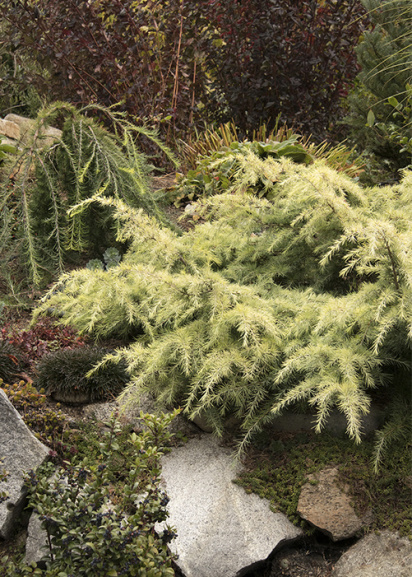

| Description | A useful rounded evergreen shrub with rich blue-green needles on dense, horizontal branches, and attractive reddish bark. A great landscape accent or foundation plant. A slow-grower that tolerates regular pruning; well-suited for training into topiary forms. |
|---|---|
| Bloom Time | Conifer; prized for foliage. |
| Deciduous/Evergreen | Evergreen |
| Special Features | Easy Care, Showy Fruit, Waterwise, Compact Form, Benefits Birds |
| Problems/Solutions | Rabbit Resistant |
| Growth Rate | Slow |
| Growth Habit | Rounded |
| Landscape Use | Container, Windbreak, Suitable for Topiary |
| Design Ideas | This is an excellent small Pine for use in spatially challenged landscapes or where windy conditions take their toll on taller species. Multiple trunks and irregular growth make this an ideal coastal Pine. Great for view lots where trees won't block the vista. Makes a fine specimen in the Asian garden and in Mediterranean schemes, woodland and Northern-style country gardens. The attractive bark is a welcome source of color in low-maintenance courtyards and those filled with dryland plants. Particularly good choice with landscape boulders and dry streambeds. |
| Foliage Color | Blue-green |
| Companion Plants | Switch Grass (Panicum); False Cypress (Chamaecyparis); Black-Eyed Susan (Rudbeckia); Russian Sage (Perovskia); Coneflower (Echinacea) |
| Care Instructions | Provide enriched, loamy, well-drained soil. Water deeply and regularly during the first growing season to establish an extensive root system; once established, reduce frequency. Feed with a general purpose fertilizer before new growth begins in spring. Prune as needed to maintain topiary size and shape. |
| History | This is a small stature cultivar that grows to just 6 feet tall, which was derived from a species that can attain a height of 100 feet or more. This forest pine is native to the very cold northern regions over a large range from Siberia west across Europe to Scotland where it received its Anglo-centric common name. These trees are highly adapted to very damp, cold and acidic soil and for that reason have proven useful in problem winter climates. It was classified by Linnaeus in the 18th century, who named both its genus and species. Trees were first introduced into North America in colonial times. This variety is more of a shrub and valued for its size, hardiness and color. |
Details
| Description | A useful rounded evergreen shrub with rich blue-green needles on dense, horizontal branches, and attractive reddish bark. A great landscape accent or foundation plant. A slow-grower that tolerates regular pruning; well-suited for training into topiary forms. |
|---|---|
| Bloom Time | Conifer; prized for foliage. |
| Deciduous/Evergreen | Evergreen |
| Special Features | Easy Care, Showy Fruit, Waterwise, Compact Form, Benefits Birds |
| Problems/Solutions | Rabbit Resistant |
| Growth Rate | Slow |
| Growth Habit | Rounded |
Style
| Landscape Use | Container, Windbreak, Suitable for Topiary |
|---|---|
| Design Ideas | This is an excellent small Pine for use in spatially challenged landscapes or where windy conditions take their toll on taller species. Multiple trunks and irregular growth make this an ideal coastal Pine. Great for view lots where trees won't block the vista. Makes a fine specimen in the Asian garden and in Mediterranean schemes, woodland and Northern-style country gardens. The attractive bark is a welcome source of color in low-maintenance courtyards and those filled with dryland plants. Particularly good choice with landscape boulders and dry streambeds. |
| Foliage Color | Blue-green |
| Companion Plants | Switch Grass (Panicum); False Cypress (Chamaecyparis); Black-Eyed Susan (Rudbeckia); Russian Sage (Perovskia); Coneflower (Echinacea) |
Care
| Care Instructions | Provide enriched, loamy, well-drained soil. Water deeply and regularly during the first growing season to establish an extensive root system; once established, reduce frequency. Feed with a general purpose fertilizer before new growth begins in spring. Prune as needed to maintain topiary size and shape. |
|---|
History
| History | This is a small stature cultivar that grows to just 6 feet tall, which was derived from a species that can attain a height of 100 feet or more. This forest pine is native to the very cold northern regions over a large range from Siberia west across Europe to Scotland where it received its Anglo-centric common name. These trees are highly adapted to very damp, cold and acidic soil and for that reason have proven useful in problem winter climates. It was classified by Linnaeus in the 18th century, who named both its genus and species. Trees were first introduced into North America in colonial times. This variety is more of a shrub and valued for its size, hardiness and color. |
|---|
Retailers Near You
About Us
We have been pioneers and craftsmen in the art of growing plants for 100 years. Since our founding in Southern California by Harry E. Rosedale, Sr. in 1926, we have been absolutely dedicated and obsessed with quality.
We have been pioneers and craftsmen in the art of growing plants for nearly 100 years. Since our founding in Southern California by Harry E. Rosedale, Sr. in 1926, we have been absolutely dedicated and obsessed with quality.