
You're growing in this Zip Code:
Discover Plants for Your Area

Howard McMinn Manzanita
Arctostaphylos 'Howard McMinn'
SKU #49156
LIGHT:
Full sun, Partial sun
WATER:
Once established, water if very dry.
SIZE:
Reaches 6 to 10 ft. tall, 10 to 12 ft wide, at maturity.

Retailers Near You
Ready to Grow?
Ship Monrovia plants directly to your door. Browse a curated selection available online.
Shop Now >This Plant's Growing Zones: 7-10
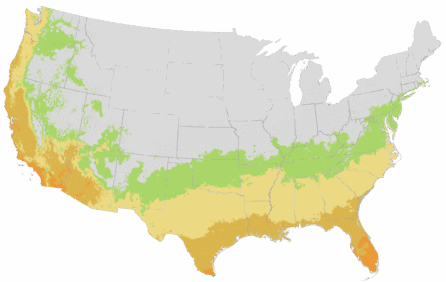
Your USDA Cold Hardiness Zone:
| Description | A large evergreen shrub with shiny green leaves and beautiful, smooth, dark red bark. Showy clusters of small white flowers are tinged with pink, blooming from late winter into spring. The flowers develop into berries that are enjoyed by animals. This wild selection from the San Franciso Bay Area requires little irrigation in coastal gardens, but can tolerate occasional watering, making it both drought and garden tolerant. Takes well to pruning and shearing. |
|---|---|
| Bloom Time | Late winter to early spring |
| Deciduous/Evergreen | Evergreen |
| Special Features | Attractive Bark, Attracts Butterflies, Attracts Hummingbirds, Waterwise, Attracts Pollinators |
| Problems/Solutions | Coastal Exposure, Deer Resistant, Drought Tolerant |
| Growth Rate | Moderate |
| Landscape Use | Barrier, Hedge, Hillside |
| Flower Color | White |
| Foliage Color | Green |
| Care Instructions | Howard McMinn is tolerant of different types of soils, however, waterlogged soils should be avoided. Stop irrigating after it is established; generally after one or two years. Extra irrigation in summer will result in a short-lived shrub. Prune in fall to remove dead or dying wood, or to improve the shape. Howard McMinn takes shearing well and can be used for a hedge. Plant in full sun in coastal sites, and sun or part shade if planted inland. |
| History | Howard McMinn is a selection grown from seed collected in the San Franciso Bay Area. The exact species present in this hybrid is not known for certain. It was originally thought to be a hybrid of Arctostaphylos stanfordiana and A. densiflora, but there is a good possibility of several other species being involved, such as A. bakeri and A. manzanita. |
| Lore | The fruit is edible for people. Traditionally they were dried and ground for a type of granulated sugar. They were also used to make cider. Manzanita is Spanish for little apple, and the fruits do indeed resemble little apples. |
Details
| Description | A large evergreen shrub with shiny green leaves and beautiful, smooth, dark red bark. Showy clusters of small white flowers are tinged with pink, blooming from late winter into spring. The flowers develop into berries that are enjoyed by animals. This wild selection from the San Franciso Bay Area requires little irrigation in coastal gardens, but can tolerate occasional watering, making it both drought and garden tolerant. Takes well to pruning and shearing. |
|---|---|
| Bloom Time | Late winter to early spring |
| Deciduous/Evergreen | Evergreen |
| Special Features | Attractive Bark, Attracts Butterflies, Attracts Hummingbirds, Waterwise, Attracts Pollinators |
| Problems/Solutions | Coastal Exposure, Deer Resistant, Drought Tolerant |
| Growth Rate | Moderate |
Style
| Landscape Use | Barrier, Hedge, Hillside |
|---|---|
| Flower Color | White |
| Foliage Color | Green |
Care
| Care Instructions | Howard McMinn is tolerant of different types of soils, however, waterlogged soils should be avoided. Stop irrigating after it is established; generally after one or two years. Extra irrigation in summer will result in a short-lived shrub. Prune in fall to remove dead or dying wood, or to improve the shape. Howard McMinn takes shearing well and can be used for a hedge. Plant in full sun in coastal sites, and sun or part shade if planted inland. |
|---|
History
| History | Howard McMinn is a selection grown from seed collected in the San Franciso Bay Area. The exact species present in this hybrid is not known for certain. It was originally thought to be a hybrid of Arctostaphylos stanfordiana and A. densiflora, but there is a good possibility of several other species being involved, such as A. bakeri and A. manzanita. |
|---|---|
| Lore | The fruit is edible for people. Traditionally they were dried and ground for a type of granulated sugar. They were also used to make cider. Manzanita is Spanish for little apple, and the fruits do indeed resemble little apples. |
Retailers Near You
About Us
We have been pioneers and craftsmen in the art of growing plants for 100 years. Since our founding in Southern California by Harry E. Rosedale, Sr. in 1926, we have been absolutely dedicated and obsessed with quality.
We have been pioneers and craftsmen in the art of growing plants for nearly 100 years. Since our founding in Southern California by Harry E. Rosedale, Sr. in 1926, we have been absolutely dedicated and obsessed with quality.