
You're growing in this Zip Code:
Change LocationDiscover Plants for Your Area
Irish Yew
Taxus baccata 'Stricta' ('Fastigiata')
Pronunciation: TAKS-us ba-KA-ta
SKU #08169
LIGHT:
Full sun, Partial sun
WATER:
Water when top 2 inches of soil is dry.
SIZE:
Slow growing; reaches 15 to 30 ft. tall, 4 to 8 ft. wide.

Retailers Near You
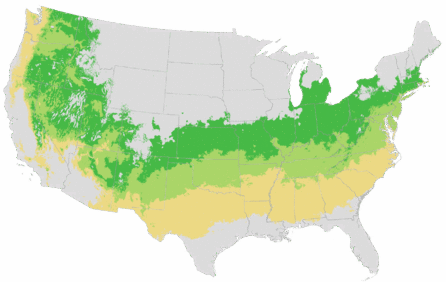
Be Inspired: How to Use this Plant


| Description | A handsome evergreen shrub with a narrow columnar form. Its rich dark green needles are larger than that of English Yew, densely cloaking its strong upright branches. May set red berry-like fruit in late spring to summer. Creates exceptional vertical interest. An excellent tall hedge or screen, easily clipped into formal or topiary shapes. |
|---|---|
| Bloom Time | Conifer; prized for foliage. |
| Deciduous/Evergreen | Evergreen |
| Special Features | Easy Care, Ornamental Berries |
| Problems/Solutions | Rabbit Resistant |
| Growth Rate | Slow |
| Landscape Use | Hedge, Privacy Screen, Suitable for Topiary |
| Design Ideas | The symmetrical, distinctively columnar shape of this stately shrub delivers a bold statement in formal groupings. Highly effective as a foundation or accent specimen, providing an exceptional vertical effect in the landscape. Excellent evergreen support for foreground plantings. Plant in mass to create a handsome tall hedge or privacy screen. |
| Foliage Color | Dark Green |
| Companion Plants | Lilac (Syringa); Viburnum (Viburnum); Potentilla (Potentilla); Weigela (Weigela); Spirea (Spiraea); Periwinkle (Vinca) |
| Care Instructions | Easily adapts to most well-drained soils. Water deeply, regularly during the first growing season to establish an extensive root system; reduce frequency, once established. Fertilize before new growth begins in spring. For a neat appearance, prune annually to shape in early spring. |
| History | Taxus baccata 'Fastigiata' (syn. T. baccata 'Stricta') was discovered by a farmer in the late 1700's in County Fermanagh, Northern Ireland. There are now several 'Fastigiata' types in cultivation, with variations including even more narrow growth habit, light green to yellow foliage, and variegated forms. |
| Lore | All species of the genus Taxus are poisonous if ingested. One American species is the source of the cancer drug, Taxol. In England yew trees were restricted to church yards where they were not subject to livestock grazing, which caused many animal deaths in the past. Interestingly, deer may graze on them, unaffected. Birds are also attracted to the fruit, which they eat without consequence, as the flesh is not toxic to most, and the seed passes through intact. Male flowers can appear occasionally on Irish Yew, resulting in setting of brightly colored drupes on this generally female plant. |
Details
| Description | A handsome evergreen shrub with a narrow columnar form. Its rich dark green needles are larger than that of English Yew, densely cloaking its strong upright branches. May set red berry-like fruit in late spring to summer. Creates exceptional vertical interest. An excellent tall hedge or screen, easily clipped into formal or topiary shapes. |
|---|---|
| Bloom Time | Conifer; prized for foliage. |
| Deciduous/Evergreen | Evergreen |
| Special Features | Easy Care, Ornamental Berries |
| Problems/Solutions | Rabbit Resistant |
| Growth Rate | Slow |
Style
| Landscape Use | Hedge, Privacy Screen, Suitable for Topiary |
|---|---|
| Design Ideas | The symmetrical, distinctively columnar shape of this stately shrub delivers a bold statement in formal groupings. Highly effective as a foundation or accent specimen, providing an exceptional vertical effect in the landscape. Excellent evergreen support for foreground plantings. Plant in mass to create a handsome tall hedge or privacy screen. |
| Foliage Color | Dark Green |
| Companion Plants | Lilac (Syringa); Viburnum (Viburnum); Potentilla (Potentilla); Weigela (Weigela); Spirea (Spiraea); Periwinkle (Vinca) |
Care
| Care Instructions | Easily adapts to most well-drained soils. Water deeply, regularly during the first growing season to establish an extensive root system; reduce frequency, once established. Fertilize before new growth begins in spring. For a neat appearance, prune annually to shape in early spring. |
|---|
History
| History | Taxus baccata 'Fastigiata' (syn. T. baccata 'Stricta') was discovered by a farmer in the late 1700's in County Fermanagh, Northern Ireland. There are now several 'Fastigiata' types in cultivation, with variations including even more narrow growth habit, light green to yellow foliage, and variegated forms. |
|---|---|
| Lore | All species of the genus Taxus are poisonous if ingested. One American species is the source of the cancer drug, Taxol. In England yew trees were restricted to church yards where they were not subject to livestock grazing, which caused many animal deaths in the past. Interestingly, deer may graze on them, unaffected. Birds are also attracted to the fruit, which they eat without consequence, as the flesh is not toxic to most, and the seed passes through intact. Male flowers can appear occasionally on Irish Yew, resulting in setting of brightly colored drupes on this generally female plant. |
Retailers Near You
About Us
We have been pioneers and craftsmen in the art of growing plants for 100 years. Since our founding in Southern California by Harry E. Rosedale, Sr. in 1926, we have been absolutely dedicated and obsessed with quality.
We have been pioneers and craftsmen in the art of growing plants for nearly 100 years. Since our founding in Southern California by Harry E. Rosedale, Sr. in 1926, we have been absolutely dedicated and obsessed with quality.