
You're growing in this Zip Code:
Change LocationDiscover Plants for Your Area
Georgia Petite Indian Hawthorn
Rhaphiolepis x delacourii 'Georgia Petite'
Pronunciation: raf-i-OL-e-pis
SKU #02006
LIGHT:
Full sun, Partial sun
WATER:
Water when top 3 inches of soil is dry.
SIZE:
Moderate growing; reaches 2 to 3 ft. tall, 3 to 4 ft. wide.

Retailers Near You
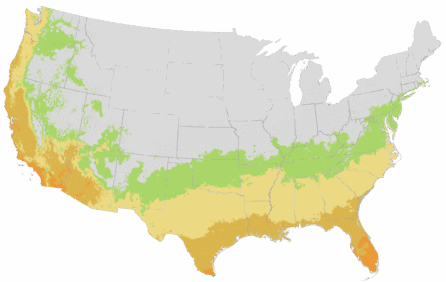
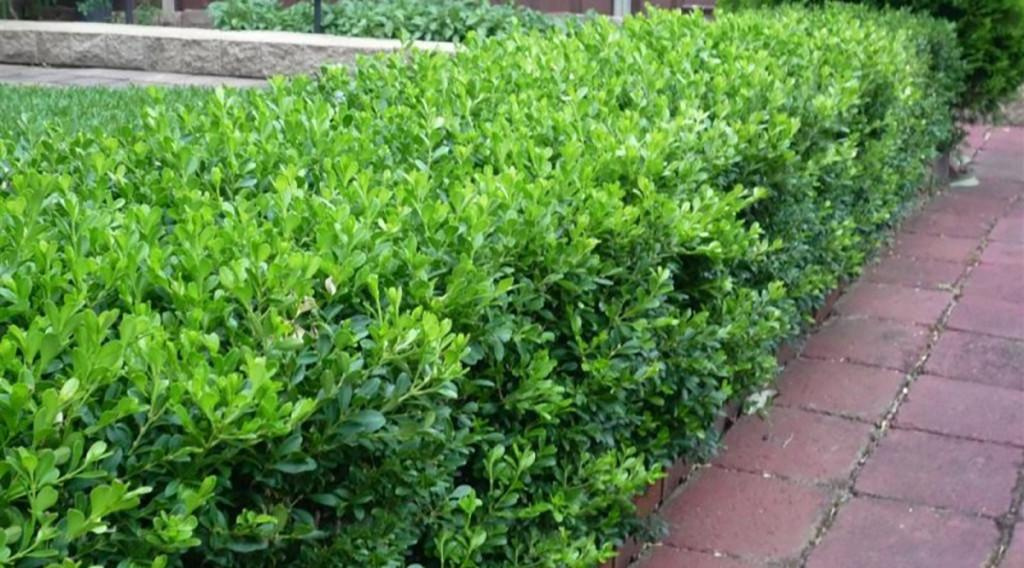

| Description | A greatly improved selection prized for its strong disease resistance and dense, compact growth habit, accentuated by dark green foliage. Abundant, white, popcorn-like flowers emerge from pink buds, followed by dark blue ornamental berries. Very useful in both small and large-scale landscapes, low hedges or as a groundcover. Evergreen. |
|---|---|
| Bloom Time | Spring |
| Deciduous/Evergreen | Evergreen |
| Special Features | Easy Care, Improved Pest and Disease Resistance, Ornamental Berries, Waterwise, Compact Form |
| Problems/Solutions | Coastal Exposure, Drought Tolerant |
| Growth Rate | Moderate |
| Flower Attributes | Showy Flowers |
| Patent Act | Asexual reproduction of plants protected by the Plant Patent Act is prohibited during the life of the patent. |
| Landscape Use | Border, Hedge |
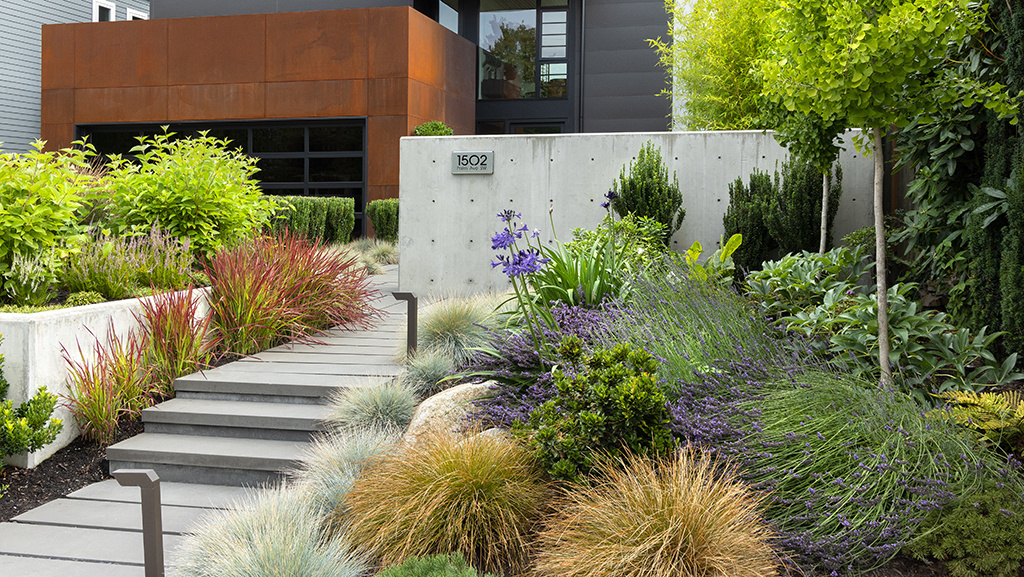
| Design Ideas | An outstanding performer that offers multi-season interest for smallish homes. Choice grouped into foundation planting. Short stature is perfect beneath large picture windows. Use in mixed borders as singles or grouped for larger color splash. Line up into informal hedge or edging along pavement. Plant along the base of picket fences or to cloak seat wall footings. Well behaved choice for raised planters. |
| Flower Color | Pink |
| Foliage Color | Dark Green |
| Companion Plants | Aucuba (Aucuba); California Lilac (Ceanothus); Rosemary (Rosmarinus); Cotoneaster (Cotoneaster); Loropetalum (Loropetalum) |
| Care Instructions | Grows easily in average, well-drained soils. Water deeply and regularly during the first growing season to establish an extensive root system. Once established, reduce frequency; tolerates moderate drought. Fertilize before new growth begins in spring. For a formal appearance, prune annually after flowering. |
| History | Indian hawthorn cultivars link back to one primary species, Raphiolepis indica, a native of southern China and Indonesia. It's native habitat is hillsides from sea level to four thousand feet in elevation. Of the six wild species only two are in cludinvation. The genus was named by John Lindley, among th emost influential directions of the Royal Horticultural Society. It's common name, hawthorne is a misnomer as it was originally grouped with true hawthornes in their genus Crataegus. Though common in the wild in Asia, they were never garden plants there. |
| Lore | Entomosporium leaf spot fungus has plagued Indian Hawthorn in the southern United States. Dr. Will Corley's efforts to breed fungus resistant varieties at the University of Georgia has yielded 'Georgia Petite'. It is derived from R. delacourii, itself a hybrid of R. indica and R. umbellata bred decades ago by M. Delacour at Cannes, France. |
Details
| Description | A greatly improved selection prized for its strong disease resistance and dense, compact growth habit, accentuated by dark green foliage. Abundant, white, popcorn-like flowers emerge from pink buds, followed by dark blue ornamental berries. Very useful in both small and large-scale landscapes, low hedges or as a groundcover. Evergreen. |
|---|---|
| Bloom Time | Spring |
| Deciduous/Evergreen | Evergreen |
| Special Features | Easy Care, Improved Pest and Disease Resistance, Ornamental Berries, Waterwise, Compact Form |
| Problems/Solutions | Coastal Exposure, Drought Tolerant |
| Growth Rate | Moderate |
| Flower Attributes | Showy Flowers |
| Patent Act | Asexual reproduction of plants protected by the Plant Patent Act is prohibited during the life of the patent. |
Style
| Landscape Use | Border, Hedge |
|---|---|
| Design Ideas | An outstanding performer that offers multi-season interest for smallish homes. Choice grouped into foundation planting. Short stature is perfect beneath large picture windows. Use in mixed borders as singles or grouped for larger color splash. Line up into informal hedge or edging along pavement. Plant along the base of picket fences or to cloak seat wall footings. Well behaved choice for raised planters. |
| Flower Color | Pink |
| Foliage Color | Dark Green |
| Companion Plants | Aucuba (Aucuba); California Lilac (Ceanothus); Rosemary (Rosmarinus); Cotoneaster (Cotoneaster); Loropetalum (Loropetalum) |
Care
| Care Instructions | Grows easily in average, well-drained soils. Water deeply and regularly during the first growing season to establish an extensive root system. Once established, reduce frequency; tolerates moderate drought. Fertilize before new growth begins in spring. For a formal appearance, prune annually after flowering. |
|---|
History
| History | Indian hawthorn cultivars link back to one primary species, Raphiolepis indica, a native of southern China and Indonesia. It's native habitat is hillsides from sea level to four thousand feet in elevation. Of the six wild species only two are in cludinvation. The genus was named by John Lindley, among th emost influential directions of the Royal Horticultural Society. It's common name, hawthorne is a misnomer as it was originally grouped with true hawthornes in their genus Crataegus. Though common in the wild in Asia, they were never garden plants there. |
|---|---|
| Lore | Entomosporium leaf spot fungus has plagued Indian Hawthorn in the southern United States. Dr. Will Corley's efforts to breed fungus resistant varieties at the University of Georgia has yielded 'Georgia Petite'. It is derived from R. delacourii, itself a hybrid of R. indica and R. umbellata bred decades ago by M. Delacour at Cannes, France. |
Retailers Near You
About Us
We have been pioneers and craftsmen in the art of growing plants for 100 years. Since our founding in Southern California by Harry E. Rosedale, Sr. in 1926, we have been absolutely dedicated and obsessed with quality.
We have been pioneers and craftsmen in the art of growing plants for nearly 100 years. Since our founding in Southern California by Harry E. Rosedale, Sr. in 1926, we have been absolutely dedicated and obsessed with quality.