
You're growing in this Zip Code:
Change LocationDiscover Plants for Your Area
Amethyst Falls American Wisteria
Wisteria frutescens 'Amethyst Falls'
Pronunciation: wis-TEE-ri-a froo-TESS-enz
SKU #07681
LIGHT:
Full sun, Partial sun
WATER:
Water when top 2 inches of soil is dry.
SIZE:
Twining stems quickly reach 8 to 10 ft. long; over time may reach 30 ft.

Retailers Near You
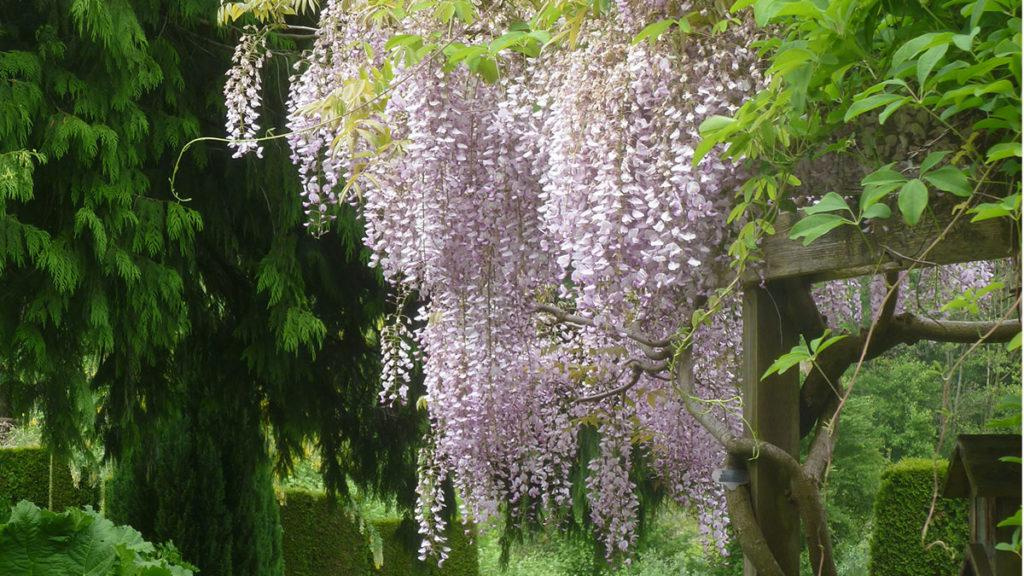

| Description | Perfect for smaller spaces, this gorgeous twining vine grows at about a third of the rate of Asian wisteria. Blooms at an early age, with its lightly fragrant purple racemes weeping gracefully downward. Use in containers for porch or patio, train up an arbor or trellis, or as a small free-standing tree. Deciduous. |
|---|---|
| Bloom Time | Late spring, repeating lightly in summer. |
| Deciduous/Evergreen | Deciduous |
| Special Features | Waterwise, Attracts Pollinators, Fast Growing |
| Problems/Solutions | Deer Resistant, Rabbit Resistant |
| Growth Rate | Fast |
| Flower Attributes | Fragrant, Repeat Flowering, Showy Flowers |
| Landscape Use | Container, Espalier, Privacy Screen |
| Flower Color | Purple |
| Foliage Color | Green |
| Companion Plants | Rose (Rosa); Daylily (Hemerocallis); Salvia (Salvia); Shasta Daisy (Chrysanthemum); Phlox (Phlox) |
| Care Instructions | Provide enriched, humusy, slightly acidic, well-drained soil. Water deeply and regularly during first growing season to establish an extensive root system; reduce frequency once established. Apply fertilizer in early spring. Trim lightly after flowering to promote repeat bloom. Prune in late winter to shape and control size. |
| History | Wisteria frutescens, commonly referred to as American Wisteria, is native to the eastern U.S., where it grows in moist areas such as stream borders, damp thickets and swampy woods. Its native range spans north to south from Virginia to Florida, and west to Illinois and Texas. |
| Lore | The branches and stems of Wisteria frutescens (American wisteria) and Wisteria sinensis (Chinese wisteria) twine in a counterclockwise direction, while Wisteria floribunda (Japanese wisteria) twines clockwise. |
Details
| Description | Perfect for smaller spaces, this gorgeous twining vine grows at about a third of the rate of Asian wisteria. Blooms at an early age, with its lightly fragrant purple racemes weeping gracefully downward. Use in containers for porch or patio, train up an arbor or trellis, or as a small free-standing tree. Deciduous. |
|---|---|
| Bloom Time | Late spring, repeating lightly in summer. |
| Deciduous/Evergreen | Deciduous |
| Special Features | Waterwise, Attracts Pollinators, Fast Growing |
| Problems/Solutions | Deer Resistant, Rabbit Resistant |
| Growth Rate | Fast |
| Flower Attributes | Fragrant, Repeat Flowering, Showy Flowers |
Style
| Landscape Use | Container, Espalier, Privacy Screen |
|---|---|
| Flower Color | Purple |
| Foliage Color | Green |
| Companion Plants | Rose (Rosa); Daylily (Hemerocallis); Salvia (Salvia); Shasta Daisy (Chrysanthemum); Phlox (Phlox) |
Care
| Care Instructions | Provide enriched, humusy, slightly acidic, well-drained soil. Water deeply and regularly during first growing season to establish an extensive root system; reduce frequency once established. Apply fertilizer in early spring. Trim lightly after flowering to promote repeat bloom. Prune in late winter to shape and control size. |
|---|
History
| History | Wisteria frutescens, commonly referred to as American Wisteria, is native to the eastern U.S., where it grows in moist areas such as stream borders, damp thickets and swampy woods. Its native range spans north to south from Virginia to Florida, and west to Illinois and Texas. |
|---|---|
| Lore | The branches and stems of Wisteria frutescens (American wisteria) and Wisteria sinensis (Chinese wisteria) twine in a counterclockwise direction, while Wisteria floribunda (Japanese wisteria) twines clockwise. |
Retailers Near You
About Us
We have been pioneers and craftsmen in the art of growing plants for 100 years. Since our founding in Southern California by Harry E. Rosedale, Sr. in 1926, we have been absolutely dedicated and obsessed with quality.
We have been pioneers and craftsmen in the art of growing plants for nearly 100 years. Since our founding in Southern California by Harry E. Rosedale, Sr. in 1926, we have been absolutely dedicated and obsessed with quality.