
You're growing in this Zip Code:
Change LocationDiscover Plants for Your Area
Dwarf Giant Banana
Musa acuminata 'Enano Gigante'
Pronunciation: MEW-sa a-ku-mi-NA-ta
SKU #06193
LIGHT:
Full sun
WATER:
Water when surface of soil is dry.
SIZE:
Fast growing clumps to 6 to 8 ft. tall and wide.

Retailers Near You
Ready to Grow?
Ship Monrovia plants directly to your door. Browse a curated selection available online.
Shop Now >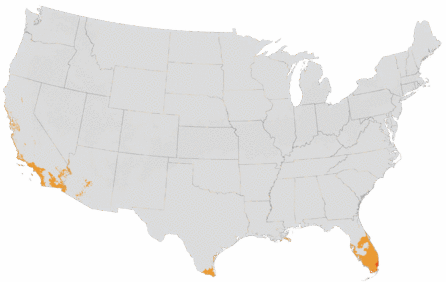

| Description | A versatile, dwarf form with large dark green leaves and red markings on juvenile foliage. Mature leaves are solid green. Produces bunches of delicious fruit. Shorter stature limits wind damage. Ideal specimen in a perennial or tropical border. Perennial. |
|---|---|
| Bloom Time | Summer |
| Deciduous/Evergreen | Evergreen |
| Special Features | Dramatic Foliage Color, Non-toxic to Cats and Dogs, Edible, Fast Growing, Compact Form |
| Growth Rate | Fast |
| Growth Habit | Clumping |
| Flower Attributes | Showy Flowers |
| Landscape Use | Border, Container, Poolside |
| Design Ideas | This banana is the cornerstone of the tropical fruit garden, but is so ornamental it is used in many kinds of gardens. Tall narrow form makes it an ideal plant for side yards as fruit tree or leafy privacy screen. Plant in small city gardens as a single specimen. Though listed as a dwarf, this is still a very wide, bushy plant that can beautifully anchor house corners in the front yard landscape. |
| Flower Color | Yellow |
| Foliage Color | Green |
| Companion Plants | To create a tropical-fruit garden, combine this Banana with Clementine Mandarine Orange (Citrus reticulata 'Clementine'), Pineapple Guava (Feijoa sellowiana) and Vincent Kiwi Vine (Actinidia chinensis 'Vincent') with its male pollenizer, Tomuri Kiwi Vine (Actinidia chinensis 'Tomuri'). Also grows very well under the light filtered shade of Jacaranda (Jacaranda mimosifolia) surrounded by Silver Dragon Lilyturf (Liriope spicata 'Silver Dragon'). |
| Care Instructions | Follow a regular watering schedule during the first growing season to establish a deep, extensive root system. Watering can be reduced after establishment. Feed with a general purpose fertilizer before new growth begins in spring. |
| History | There are over 40 species in this large, well known genus of edible tropical fruit. They are distributed throughout southeast Asia and the South Pacific. This commercially cultivated species includes many varieties and forms native to Asia and parts of tropical East Africa. |
| Lore | The genus was named for Antonio Musa, physician to Octavius Augustus, the first emperor of Rome, 63-14 BC. |
Details
| Description | A versatile, dwarf form with large dark green leaves and red markings on juvenile foliage. Mature leaves are solid green. Produces bunches of delicious fruit. Shorter stature limits wind damage. Ideal specimen in a perennial or tropical border. Perennial. |
|---|---|
| Bloom Time | Summer |
| Deciduous/Evergreen | Evergreen |
| Special Features | Dramatic Foliage Color, Non-toxic to Cats and Dogs, Edible, Fast Growing, Compact Form |
| Growth Rate | Fast |
| Growth Habit | Clumping |
| Flower Attributes | Showy Flowers |
Style
| Landscape Use | Border, Container, Poolside |
|---|---|
| Design Ideas | This banana is the cornerstone of the tropical fruit garden, but is so ornamental it is used in many kinds of gardens. Tall narrow form makes it an ideal plant for side yards as fruit tree or leafy privacy screen. Plant in small city gardens as a single specimen. Though listed as a dwarf, this is still a very wide, bushy plant that can beautifully anchor house corners in the front yard landscape. |
| Flower Color | Yellow |
| Foliage Color | Green |
| Companion Plants | To create a tropical-fruit garden, combine this Banana with Clementine Mandarine Orange (Citrus reticulata 'Clementine'), Pineapple Guava (Feijoa sellowiana) and Vincent Kiwi Vine (Actinidia chinensis 'Vincent') with its male pollenizer, Tomuri Kiwi Vine (Actinidia chinensis 'Tomuri'). Also grows very well under the light filtered shade of Jacaranda (Jacaranda mimosifolia) surrounded by Silver Dragon Lilyturf (Liriope spicata 'Silver Dragon'). |
Care
| Care Instructions | Follow a regular watering schedule during the first growing season to establish a deep, extensive root system. Watering can be reduced after establishment. Feed with a general purpose fertilizer before new growth begins in spring. |
|---|
History
| History | There are over 40 species in this large, well known genus of edible tropical fruit. They are distributed throughout southeast Asia and the South Pacific. This commercially cultivated species includes many varieties and forms native to Asia and parts of tropical East Africa. |
|---|---|
| Lore | The genus was named for Antonio Musa, physician to Octavius Augustus, the first emperor of Rome, 63-14 BC. |
Frequently asked questions
Does Dwarf Giant Banana produce flowers?
Summer
Is Dwarf Giant Banana evergreen or deciduous?
Dwarf Giant Banana is Evergreen.
What are the special features of Dwarf Giant Banana?
Dwarf Giant Banana is Dramatic Foliage Color, Non-toxic to Cats and Dogs, Edible, Fast Growing, Compact Form.
How fast does Dwarf Giant Banana grow?
Dwarf Giant Banana has a Fast growth rate.
What is the growth habit of Dwarf Giant Banana?
Dwarf Giant Banana grows in an Clumping habit.
Where can I use Dwarf Giant Banana in my landscape?
Dwarf Giant Banana is suitable for: Border, Container, Poolside.
How can I use Dwarf Giant Banana in my garden design?
This banana is the cornerstone of the tropical fruit garden, but is so ornamental it is used in many kinds of gardens. Tall narrow form makes it an ideal plant for side yards as fruit tree or leafy privacy screen. Plant in small city gardens as a single specimen. Though listed as a dwarf, this is still a very wide, bushy plant that can beautifully anchor house corners in the front yard landscape.
What color are Dwarf Giant Banana flowers?
Dwarf Giant Banana produces Yellow flowers.
What color is the foliage of Dwarf Giant Banana?
Dwarf Giant Banana has Green foliage.
What plants grow well with Dwarf Giant Banana?
Good companion plants for Dwarf Giant Banana include: To create a tropical-fruit garden, combine this Banana with Clementine Mandarine Orange (Citrus reticulata 'Clementine'), Pineapple Guava (Feijoa sellowiana) and Vincent Kiwi Vine (Actinidia chinensis 'Vincent') with its male pollenizer, Tomuri Kiwi Vine (Actinidia chinensis 'Tomuri'). Also grows very well under the light filtered shade of Jacaranda (Jacaranda mimosifolia) surrounded by Silver Dragon Lilyturf (Liriope spicata 'Silver Dragon')..
How do I care for Dwarf Giant Banana?
Follow a regular watering schedule during the first growing season to establish a deep, extensive root system. Watering can be reduced after establishment. Feed with a general purpose fertilizer before new growth begins in spring.
What is the history of Dwarf Giant Banana?
There are over 40 species in this large, well known genus of edible tropical fruit. They are distributed throughout southeast Asia and the South Pacific. This commercially cultivated species includes many varieties and forms native to Asia and parts of tropical East Africa.
Retailers Near You
About Us
We have been pioneers and craftsmen in the art of growing plants for 100 years. Since our founding in Southern California by Harry E. Rosedale, Sr. in 1926, we have been absolutely dedicated and obsessed with quality.
We have been pioneers and craftsmen in the art of growing plants for nearly 100 years. Since our founding in Southern California by Harry E. Rosedale, Sr. in 1926, we have been absolutely dedicated and obsessed with quality.