
You're growing in this Zip Code:
Change LocationDiscover Plants for Your Area
Northern Bayberry
Myrica pennsylvanica
Pronunciation: mi-RY-ka pen-sil-VAN-i-ka
SKU #06218
LIGHT:
Full sun, Partial sun
WATER:
Water when top 3 in. of soil is dry.
SIZE:
Moderate growing to 9 ft. tall, equal width.

Retailers Near You
Ready to Grow?
Ship Monrovia plants directly to your door. Browse a curated selection available online.
Shop Now >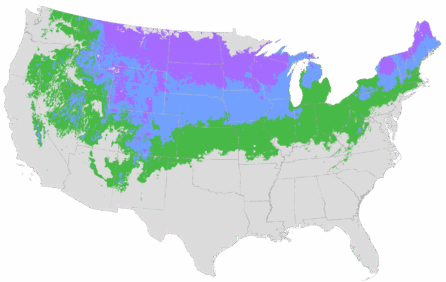
| Description | Fragrant, dense foliage on a compact form makes this shrub useful for hedges and screens. This American native thrives in the worst alkaline sandy soils. Best friend to gardeners of the East Coast. Evergreen in mild climates, deciduous elsewhere. |
|---|---|
| Bloom Time | Inconspicuous; prized for foliage. |
| Deciduous/Evergreen | Evergreen |
| Special Features | Ornamental Berries, Waterwise, North American Native, Compact Form, Benefits Birds |
| Problems/Solutions | Coastal Exposure, Deer Resistant, Very Wet Areas |
| Growth Rate | Moderate |
| Growth Habit | Rounded |
| Landscape Use | Privacy Screen |
| Design Ideas | Fragrant foliage can be sheared to release more scent. Popular in formal and wild gardens. A big bushy shrub, it can be used as a single specimen or ganged into a low-maintenance hedge. Perfect for transition areas between cultivated garden and native ecosystems. |
| Flower Color | Green |
| Foliage Color | Green |
| Companion Plants | Kinnikinick (Arctostaphyllus ); Oregon Grape Holly (Mahonia); Potentilla (Potentilla); Cranberry Bush (Viburnum); Magnolia (Magnolia) |
| Care Instructions | Follow a regular watering schedule during the first growing season to establish a deep, extensive root system. May be watered deeply, less frequently, when established. Feed with a general purpose fertilizer before new growth begins in spring. For a tidy, neat appearance, shear annually to shape. |
| History | This native shrub is found over an enormous range of the eastern states from Newfoundland to Maryland. This species was classified by French botanist Jean Loiseleur-Deslongchamps (1774-1849). |
| Lore | This is a diecious plant with berries held more densely on female clones. The white waxy coating on the small fruits is used for candle making. |
Details
| Description | Fragrant, dense foliage on a compact form makes this shrub useful for hedges and screens. This American native thrives in the worst alkaline sandy soils. Best friend to gardeners of the East Coast. Evergreen in mild climates, deciduous elsewhere. |
|---|---|
| Bloom Time | Inconspicuous; prized for foliage. |
| Deciduous/Evergreen | Evergreen |
| Special Features | Ornamental Berries, Waterwise, North American Native, Compact Form, Benefits Birds |
| Problems/Solutions | Coastal Exposure, Deer Resistant, Very Wet Areas |
| Growth Rate | Moderate |
| Growth Habit | Rounded |
Style
| Landscape Use | Privacy Screen |
|---|---|
| Design Ideas | Fragrant foliage can be sheared to release more scent. Popular in formal and wild gardens. A big bushy shrub, it can be used as a single specimen or ganged into a low-maintenance hedge. Perfect for transition areas between cultivated garden and native ecosystems. |
| Flower Color | Green |
| Foliage Color | Green |
| Companion Plants | Kinnikinick (Arctostaphyllus ); Oregon Grape Holly (Mahonia); Potentilla (Potentilla); Cranberry Bush (Viburnum); Magnolia (Magnolia) |
Care
| Care Instructions | Follow a regular watering schedule during the first growing season to establish a deep, extensive root system. May be watered deeply, less frequently, when established. Feed with a general purpose fertilizer before new growth begins in spring. For a tidy, neat appearance, shear annually to shape. |
|---|
History
| History | This native shrub is found over an enormous range of the eastern states from Newfoundland to Maryland. This species was classified by French botanist Jean Loiseleur-Deslongchamps (1774-1849). |
|---|---|
| Lore | This is a diecious plant with berries held more densely on female clones. The white waxy coating on the small fruits is used for candle making. |
Frequently asked questions
Does Northern Bayberry produce flowers?
Inconspicuous; prized for foliage.
Is Northern Bayberry evergreen or deciduous?
Northern Bayberry is Evergreen.
What are the special features of Northern Bayberry?
Northern Bayberry is Ornamental Berries, Waterwise, North American Native, Compact Form, Benefits Birds.
Is Northern Bayberry resistant to pests or animals?
Coastal Exposure, Deer Resistant, Very Wet Areas
How fast does Northern Bayberry grow?
Northern Bayberry has a Moderate growth rate.
What is the growth habit of Northern Bayberry?
Northern Bayberry grows in an Rounded habit.
Where can I use Northern Bayberry in my landscape?
Northern Bayberry is suitable for: Privacy Screen.
How can I use Northern Bayberry in my garden design?
Fragrant foliage can be sheared to release more scent. Popular in formal and wild gardens. A big bushy shrub, it can be used as a single specimen or ganged into a low-maintenance hedge. Perfect for transition areas between cultivated garden and native ecosystems.
What color are Northern Bayberry flowers?
Northern Bayberry produces Green flowers.
What color is the foliage of Northern Bayberry?
Northern Bayberry has Green foliage.
What plants grow well with Northern Bayberry?
Good companion plants for Northern Bayberry include: Kinnikinick (Arctostaphyllus ); Oregon Grape Holly (Mahonia); Potentilla (Potentilla); Cranberry Bush (Viburnum); Magnolia (Magnolia).
How do I care for Northern Bayberry?
Follow a regular watering schedule during the first growing season to establish a deep, extensive root system. May be watered deeply, less frequently, when established. Feed with a general purpose fertilizer before new growth begins in spring. For a tidy, neat appearance, shear annually to shape.
What is the history of Northern Bayberry?
This native shrub is found over an enormous range of the eastern states from Newfoundland to Maryland. This species was classified by French botanist Jean Loiseleur-Deslongchamps (1774-1849).
Retailers Near You
About Us
We have been pioneers and craftsmen in the art of growing plants for 100 years. Since our founding in Southern California by Harry E. Rosedale, Sr. in 1926, we have been absolutely dedicated and obsessed with quality.
We have been pioneers and craftsmen in the art of growing plants for nearly 100 years. Since our founding in Southern California by Harry E. Rosedale, Sr. in 1926, we have been absolutely dedicated and obsessed with quality.