
You're growing in this Zip Code:
Change LocationDiscover Plants for Your Area
Helmond Pillar Barberry
Berberis thunbergii 'Helmond Pillar'
Pronunciation: BUR-bur-is thun-BER-jee-eye
SKU #01210
LIGHT:
Full sun
WATER:
Water when top 3 inches of soil is dry.
SIZE:
Slowly reaches 3 to 4 ft. tall, 1 to 2 ft. wide.

Retailers Near You
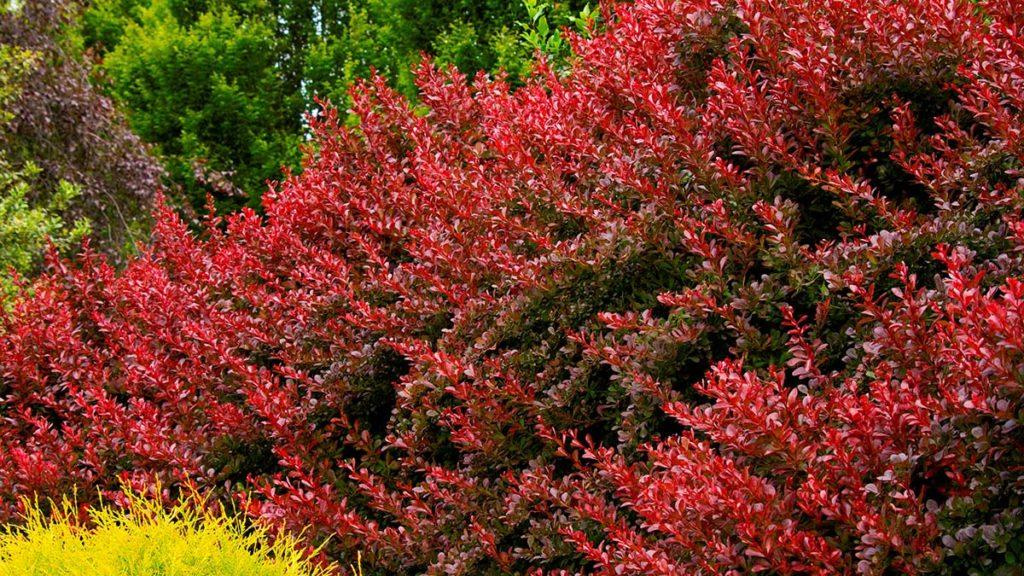

| Description | This upright, deep purplish red columnar shrub makes quite a statement in the landscape. The unique form is ideal as an architectural feature or for framing a doorway. The excellent, richly colored foliage pairs beautifully with shrubs and perennials with light green or golden foliage. Deciduous. |
|---|---|
| Bloom Time | Inconspicuous; prized for foliage. |
| Deciduous/Evergreen | Deciduous |
| Special Features | Dramatic Foliage Color, Easy Care, Ornamental Berries, Benefits Birds |
| Problems/Solutions | Deer Resistant, Drought Tolerant, Tolerates Urban Pollution, Road Salt Tolerant |
| Growth Rate | Slow |
| Landscape Use | Barrier, Border, Hedge |
| Design Ideas | Let this pillar become the central column of a mixed border composition. Particularly good in pairs flanking a fountain, work of art or gateway. Bright foliage foundation plant for narrow spans of wall between windows or at doorways. Smaller stature is perfect for small city gardens needing big garden looks in limited space. |
| Foliage Color | Burgundy |
| Companion Plants | Boxwood (Buxus); Cypress (Chamaecyparis); Potentilla (Potentilla); Spirea (Spiraea); Weigela (Weigela) |
| Care Instructions | Thrives in average, well-drained soil; avoid poorly drained, wet sites. Water deeply, regularly in first growing season to establish an extensive root system. Once established, reduce frequency; tolerates moderate drought. Fertilize before new growth begins in spring. No pruning necessary except to maintain desired shape. |
| History | The first Asian barberry known to the west was discovered in Japan by C.P. Thunberg in 1784, hence the species name. It did not arrive in Europe until a century later however. The purple forms did not appear until the 20th century, developed by a French nurseryman, M. Renault around 1920. Since overcoming issues of fungal diseases barberries are surging in interest although they are considered dangerously invasive in some states. |
| Lore | Barberries are named for their wickedly sharp barbs or thorns and for the berries that follow their flowers. |
Details
| Description | This upright, deep purplish red columnar shrub makes quite a statement in the landscape. The unique form is ideal as an architectural feature or for framing a doorway. The excellent, richly colored foliage pairs beautifully with shrubs and perennials with light green or golden foliage. Deciduous. |
|---|---|
| Bloom Time | Inconspicuous; prized for foliage. |
| Deciduous/Evergreen | Deciduous |
| Special Features | Dramatic Foliage Color, Easy Care, Ornamental Berries, Benefits Birds |
| Problems/Solutions | Deer Resistant, Drought Tolerant, Tolerates Urban Pollution, Road Salt Tolerant |
| Growth Rate | Slow |
Style
| Landscape Use | Barrier, Border, Hedge |
|---|---|
| Design Ideas | Let this pillar become the central column of a mixed border composition. Particularly good in pairs flanking a fountain, work of art or gateway. Bright foliage foundation plant for narrow spans of wall between windows or at doorways. Smaller stature is perfect for small city gardens needing big garden looks in limited space. |
| Foliage Color | Burgundy |
| Companion Plants | Boxwood (Buxus); Cypress (Chamaecyparis); Potentilla (Potentilla); Spirea (Spiraea); Weigela (Weigela) |
Care
| Care Instructions | Thrives in average, well-drained soil; avoid poorly drained, wet sites. Water deeply, regularly in first growing season to establish an extensive root system. Once established, reduce frequency; tolerates moderate drought. Fertilize before new growth begins in spring. No pruning necessary except to maintain desired shape. |
|---|
History
| History | The first Asian barberry known to the west was discovered in Japan by C.P. Thunberg in 1784, hence the species name. It did not arrive in Europe until a century later however. The purple forms did not appear until the 20th century, developed by a French nurseryman, M. Renault around 1920. Since overcoming issues of fungal diseases barberries are surging in interest although they are considered dangerously invasive in some states. |
|---|---|
| Lore | Barberries are named for their wickedly sharp barbs or thorns and for the berries that follow their flowers. |
Retailers Near You
About Us
We have been pioneers and craftsmen in the art of growing plants for 100 years. Since our founding in Southern California by Harry E. Rosedale, Sr. in 1926, we have been absolutely dedicated and obsessed with quality.
We have been pioneers and craftsmen in the art of growing plants for nearly 100 years. Since our founding in Southern California by Harry E. Rosedale, Sr. in 1926, we have been absolutely dedicated and obsessed with quality.