
You're growing in this Zip Code:
Change LocationDiscover Plants for Your Area
Thornless Chilean Mesquite
Prosopis chilensis
Pronunciation: PROS-oh-pis chil-EN-sis
SKU #06684
LIGHT:
Full sun
WATER:
Once established water deeply occasionally.
SIZE:
Moderate growing; reaches 30 ft. tall and wide with age.

Retailers Near You
Ready to Grow?
Ship Monrovia plants directly to your door. Browse a curated selection available online.
Shop Now >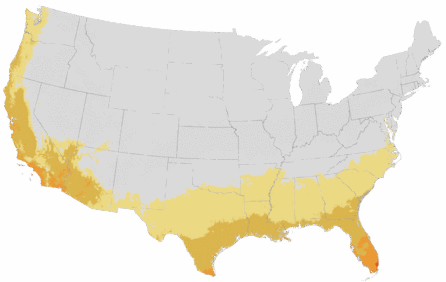

| Description | A heat-loving, drought tolerant tree with an open, airy, crown. Refined foliage and stems have a purple cast when young. An excellent specimen for a dry rock garden or waterwise landscape, or adjacent to patios or pathways in need of light shade. Planted in groups, the canopy filters harsh sunlight to reduce heat and glare. Semi-evergreen. |
|---|---|
| Bloom Time | Inconspicuous; prized for foliage. |
| Deciduous/Evergreen | Semi-Evergreen |
| Special Features | Easy Care, Waterwise, Benefits Birds |
| Problems/Solutions | Erosion Control, Drought Tolerant |
| Growth Rate | Moderate |
| Growth Habit | Spreading |
| Landscape Use | Privacy Screen |
| Design Ideas | Few trees can rival this Mesquite for its light filtered shade. A great native of the Southwest that should be planted as groves to render patios and porches less vulnerable to oppressive heat. Plant in natural groupings for best results, or as a single specimen for front yard or beside a back patio. Keep away from pools because litter is a problem. The perfect tree for Santa Fe-style or drought-resistant gardens with a decidedly tropical flare. Particularly well adapted to Western native landscapes. |
| Flower Color | Green |
| Foliage Color | Green |
| Companion Plants | Texas Ranger (Leucophyllum); Passion Flower (Passiflora); Yucca (Yucca); Bougainvillea (Bougainvillea); Ground Morning Glory (Convolvulus) |
| Care Instructions | Thrives in lean, fast-draining soils. Water deeply, regularly during the first growing season to establish an extensive root system. Once established, water only occasionally, as needed to encourage vigor; over-watering causes structurally weak wood. Fertilize lightly when new growth begins in spring. |
| History | Despite the fact that it is closely related to the mesquite of the desert Southwest, it is in fact an import from Chile where the climate is the mirror image in the Southern Hemisphere. These thornless trees fall into the pea family and like many legumes they are also nitrogen fixers. Its genus was given by the 19th century botanist, Dr. John Torrey, who classified it in his 1838 work, Flora of North America, which was co-authored with Asa Gray. Native Americans throughout its range used the trees for food fiber and implements. The Chilean mesquite has been widely planted in the Southwest and readily cross pollinates with the native species. Many spontaneous hybrids have appeared naturally which display qualities of both ancestors. |
| Lore | Genus Prosopis includes the famous trees of the American Southwest that produce nutritious pods vital to the material culture of many Native American tribes within its range. |
Details
| Description | A heat-loving, drought tolerant tree with an open, airy, crown. Refined foliage and stems have a purple cast when young. An excellent specimen for a dry rock garden or waterwise landscape, or adjacent to patios or pathways in need of light shade. Planted in groups, the canopy filters harsh sunlight to reduce heat and glare. Semi-evergreen. |
|---|---|
| Bloom Time | Inconspicuous; prized for foliage. |
| Deciduous/Evergreen | Semi-Evergreen |
| Special Features | Easy Care, Waterwise, Benefits Birds |
| Problems/Solutions | Erosion Control, Drought Tolerant |
| Growth Rate | Moderate |
| Growth Habit | Spreading |
Style
| Landscape Use | Privacy Screen |
|---|---|
| Design Ideas | Few trees can rival this Mesquite for its light filtered shade. A great native of the Southwest that should be planted as groves to render patios and porches less vulnerable to oppressive heat. Plant in natural groupings for best results, or as a single specimen for front yard or beside a back patio. Keep away from pools because litter is a problem. The perfect tree for Santa Fe-style or drought-resistant gardens with a decidedly tropical flare. Particularly well adapted to Western native landscapes. |
| Flower Color | Green |
| Foliage Color | Green |
| Companion Plants | Texas Ranger (Leucophyllum); Passion Flower (Passiflora); Yucca (Yucca); Bougainvillea (Bougainvillea); Ground Morning Glory (Convolvulus) |
Care
| Care Instructions | Thrives in lean, fast-draining soils. Water deeply, regularly during the first growing season to establish an extensive root system. Once established, water only occasionally, as needed to encourage vigor; over-watering causes structurally weak wood. Fertilize lightly when new growth begins in spring. |
|---|
History
| History | Despite the fact that it is closely related to the mesquite of the desert Southwest, it is in fact an import from Chile where the climate is the mirror image in the Southern Hemisphere. These thornless trees fall into the pea family and like many legumes they are also nitrogen fixers. Its genus was given by the 19th century botanist, Dr. John Torrey, who classified it in his 1838 work, Flora of North America, which was co-authored with Asa Gray. Native Americans throughout its range used the trees for food fiber and implements. The Chilean mesquite has been widely planted in the Southwest and readily cross pollinates with the native species. Many spontaneous hybrids have appeared naturally which display qualities of both ancestors. |
|---|---|
| Lore | Genus Prosopis includes the famous trees of the American Southwest that produce nutritious pods vital to the material culture of many Native American tribes within its range. |
Frequently asked questions
Does Thornless Chilean Mesquite produce flowers?
Inconspicuous; prized for foliage.
Is Thornless Chilean Mesquite evergreen or deciduous?
Thornless Chilean Mesquite is Semi-Evergreen.
What are the special features of Thornless Chilean Mesquite?
Thornless Chilean Mesquite is Easy Care, Waterwise, Benefits Birds.
Is Thornless Chilean Mesquite resistant to pests or animals?
Erosion Control, Drought Tolerant
How fast does Thornless Chilean Mesquite grow?
Thornless Chilean Mesquite has a Moderate growth rate.
What is the growth habit of Thornless Chilean Mesquite?
Thornless Chilean Mesquite grows in an Spreading habit.
Where can I use Thornless Chilean Mesquite in my landscape?
Thornless Chilean Mesquite is suitable for: Privacy Screen.
How can I use Thornless Chilean Mesquite in my garden design?
Few trees can rival this Mesquite for its light filtered shade. A great native of the Southwest that should be planted as groves to render patios and porches less vulnerable to oppressive heat. Plant in natural groupings for best results, or as a single specimen for front yard or beside a back patio. Keep away from pools because litter is a problem. The perfect tree for Santa Fe-style or drought-resistant gardens with a decidedly tropical flare. Particularly well adapted to Western native landscapes.
What color are Thornless Chilean Mesquite flowers?
Thornless Chilean Mesquite produces Green flowers.
What color is the foliage of Thornless Chilean Mesquite?
Thornless Chilean Mesquite has Green foliage.
What plants grow well with Thornless Chilean Mesquite?
Good companion plants for Thornless Chilean Mesquite include: Texas Ranger (Leucophyllum); Passion Flower (Passiflora); Yucca (Yucca); Bougainvillea (Bougainvillea); Ground Morning Glory (Convolvulus).
How do I care for Thornless Chilean Mesquite?
Thrives in lean, fast-draining soils. Water deeply, regularly during the first growing season to establish an extensive root system. Once established, water only occasionally, as needed to encourage vigor; over-watering causes structurally weak wood. Fertilize lightly when new growth begins in spring.
What is the history of Thornless Chilean Mesquite?
Despite the fact that it is closely related to the mesquite of the desert Southwest, it is in fact an import from Chile where the climate is the mirror image in the Southern Hemisphere. These thornless trees fall into the pea family and like many legumes they are also nitrogen fixers. Its genus was given by the 19th century botanist, Dr. John Torrey, who classified it in his 1838 work, Flora of North America, which was co-authored with Asa Gray. Native Americans throughout its range used the trees for food fiber and implements. The Chilean mesquite has been widely planted in the Southwest and readily cross pollinates with the native species. Many spontaneous hybrids have appeared naturally which display qualities of both ancestors.
Retailers Near You
About Us
We have been pioneers and craftsmen in the art of growing plants for 100 years. Since our founding in Southern California by Harry E. Rosedale, Sr. in 1926, we have been absolutely dedicated and obsessed with quality.
We have been pioneers and craftsmen in the art of growing plants for nearly 100 years. Since our founding in Southern California by Harry E. Rosedale, Sr. in 1926, we have been absolutely dedicated and obsessed with quality.