
You're growing in this Zip Code:
Change LocationDiscover Plants for Your Area
Itsy Bitsy® White False Heather
Cuphea hyssopifolia 'Monga'
Pronunciation: KYOO-fee-uh hiss-sop-ih-FOH-lee-uh
SKU #08300
LIGHT:
Full sun, Partial sun
WATER:
Keep soil moist, but not soggy.
SIZE:
Slow growing; reaches 8 to 12 in. tall, 18 to 24 in. wide.

Retailers Near You
Ready to Grow?
Ship Monrovia plants directly to your door. Browse a curated selection available online.
Shop Now >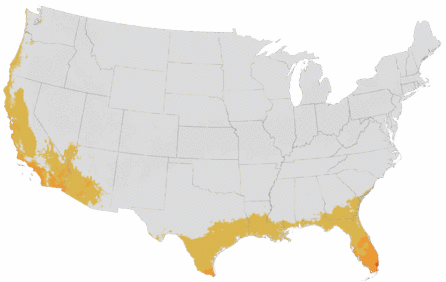
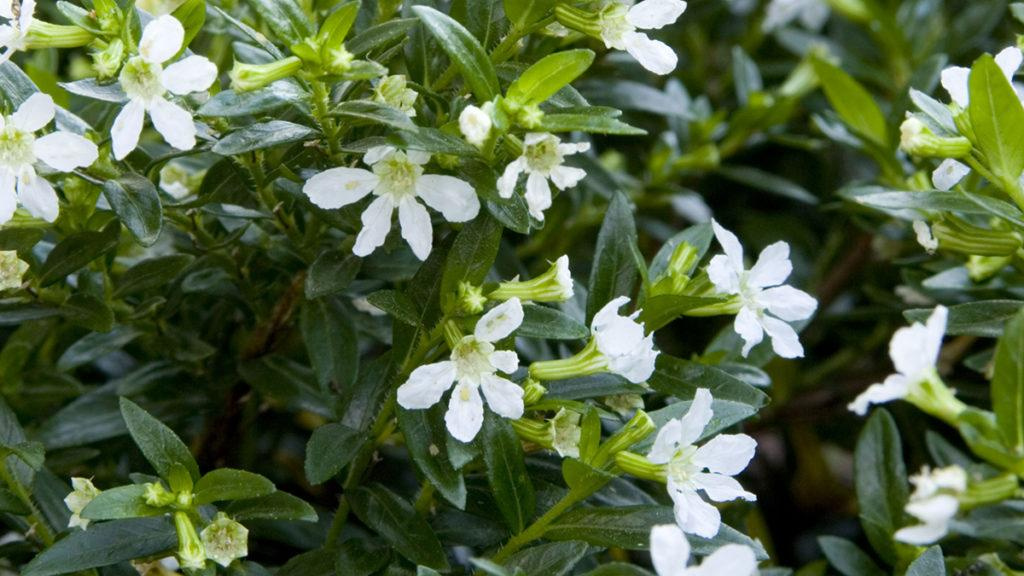
| Description | An excellent choice for rock gardens, or accenting borders. This small, ground-hugging, evergreen shrub is formed from masses of relaxed, twiggy branches holding tiny, glossy bright green leaves. Produces small white blooms nearly continuously in mild winter regions; treat as summer annual in colder areas. |
|---|---|
| Bloom Time | Summer |
| Deciduous/Evergreen | Evergreen |
| Special Features | Easy Care, Attracts Pollinators, Compact Form |
| Problems/Solutions | Coastal Exposure, Erosion Control |
| Growth Rate | Slow |
| Growth Habit | Spreading |
| Flower Attributes | Long Bloom Season, Showy Flowers |
| Landscape Use | Border, Container, Ground Cover, Edging, Hanging Basket |
| Design Ideas | Small low-growing perennials make excellent groundcover for the front of the perennial border or to cover up exposed legs on older shrubs. Equally suited for slopes and banks where drainage is assured. Destined for rock gardens where they nest the stones in foliage and color. Good edging to define a footpath or set of flagstone steppers. Spreading form will soften edges of raised planters and retaining walls. Suited to containers and best in terra cotta or porous stone troughs with good air exchange. |
| Flower Color | White |
| Foliage Color | Green |
| Companion Plants | Hebe (Hebe); Rose of Sharon (Hibiscus); Lilyturf (Liriope); Phormium (Phormium); Fountain Grass (Pennisetum); Salvia (Salvia) |
| Care Instructions | Easily grown in average, well-drained soil. Water deeply, regularly in first growing season to establish an extensive root system. Once established in the landscape, reduce frequency; continue to water container plants when soil surface becomes dry. Apply a general fertilizer in early spring. For a tidy appearance, prune annually to shape. |
| History | This hybrid was developed by Monrovia and introduced in 2001. It is derived from genus Cuphea, grouped into the Loosestrife family. It was classified by Patrick Browne (1720-1790), the Irish physician best known for writing on plants of Jamaica. Cuphea species are concentrated in tropical regions of Central America, with this one native to Mexico and parts of Guatemala. Species name alludes to the similarity of the foliage to that of the European herb, hyssop. |
| Lore | Plants and flowers are a lure for sulphur butterflies. Despite it's common name it is not related to the European or South African heathers. |
Details
| Description | An excellent choice for rock gardens, or accenting borders. This small, ground-hugging, evergreen shrub is formed from masses of relaxed, twiggy branches holding tiny, glossy bright green leaves. Produces small white blooms nearly continuously in mild winter regions; treat as summer annual in colder areas. |
|---|---|
| Bloom Time | Summer |
| Deciduous/Evergreen | Evergreen |
| Special Features | Easy Care, Attracts Pollinators, Compact Form |
| Problems/Solutions | Coastal Exposure, Erosion Control |
| Growth Rate | Slow |
| Growth Habit | Spreading |
| Flower Attributes | Long Bloom Season, Showy Flowers |
Style
| Landscape Use | Border, Container, Ground Cover, Edging, Hanging Basket |
|---|---|
| Design Ideas | Small low-growing perennials make excellent groundcover for the front of the perennial border or to cover up exposed legs on older shrubs. Equally suited for slopes and banks where drainage is assured. Destined for rock gardens where they nest the stones in foliage and color. Good edging to define a footpath or set of flagstone steppers. Spreading form will soften edges of raised planters and retaining walls. Suited to containers and best in terra cotta or porous stone troughs with good air exchange. |
| Flower Color | White |
| Foliage Color | Green |
| Companion Plants | Hebe (Hebe); Rose of Sharon (Hibiscus); Lilyturf (Liriope); Phormium (Phormium); Fountain Grass (Pennisetum); Salvia (Salvia) |
Care
| Care Instructions | Easily grown in average, well-drained soil. Water deeply, regularly in first growing season to establish an extensive root system. Once established in the landscape, reduce frequency; continue to water container plants when soil surface becomes dry. Apply a general fertilizer in early spring. For a tidy appearance, prune annually to shape. |
|---|
History
| History | This hybrid was developed by Monrovia and introduced in 2001. It is derived from genus Cuphea, grouped into the Loosestrife family. It was classified by Patrick Browne (1720-1790), the Irish physician best known for writing on plants of Jamaica. Cuphea species are concentrated in tropical regions of Central America, with this one native to Mexico and parts of Guatemala. Species name alludes to the similarity of the foliage to that of the European herb, hyssop. |
|---|---|
| Lore | Plants and flowers are a lure for sulphur butterflies. Despite it's common name it is not related to the European or South African heathers. |
Frequently asked questions
Does Itsy Bitsy® White False Heather produce flowers?
Summer
Is Itsy Bitsy® White False Heather evergreen or deciduous?
Itsy Bitsy® White False Heather is Evergreen.
What are the special features of Itsy Bitsy® White False Heather?
Itsy Bitsy® White False Heather is Easy Care, Attracts Pollinators, Compact Form.
Is Itsy Bitsy® White False Heather resistant to pests or animals?
Coastal Exposure, Erosion Control
How fast does Itsy Bitsy® White False Heather grow?
Itsy Bitsy® White False Heather has a Slow growth rate.
What is the growth habit of Itsy Bitsy® White False Heather?
Itsy Bitsy® White False Heather grows in an Spreading habit.
Where can I use Itsy Bitsy® White False Heather in my landscape?
Itsy Bitsy® White False Heather is suitable for: Border, Container, Ground Cover, Edging, Hanging Basket.
How can I use Itsy Bitsy® White False Heather in my garden design?
Small low-growing perennials make excellent groundcover for the front of the perennial border or to cover up exposed legs on older shrubs. Equally suited for slopes and banks where drainage is assured. Destined for rock gardens where they nest the stones in foliage and color. Good edging to define a footpath or set of flagstone steppers. Spreading form will soften edges of raised planters and retaining walls. Suited to containers and best in terra cotta or porous stone troughs with good air exchange.
What color are Itsy Bitsy® White False Heather flowers?
Itsy Bitsy® White False Heather produces White flowers.
What color is the foliage of Itsy Bitsy® White False Heather?
Itsy Bitsy® White False Heather has Green foliage.
What plants grow well with Itsy Bitsy® White False Heather?
Good companion plants for Itsy Bitsy® White False Heather include: Hebe (Hebe); Rose of Sharon (Hibiscus); Lilyturf (Liriope); Phormium (Phormium); Fountain Grass (Pennisetum); Salvia (Salvia).
How do I care for Itsy Bitsy® White False Heather?
Easily grown in average, well-drained soil. Water deeply, regularly in first growing season to establish an extensive root system. Once established in the landscape, reduce frequency; continue to water container plants when soil surface becomes dry. Apply a general fertilizer in early spring. For a tidy appearance, prune annually to shape.
What is the history of Itsy Bitsy® White False Heather?
This hybrid was developed by Monrovia and introduced in 2001. It is derived from genus Cuphea, grouped into the Loosestrife family. It was classified by Patrick Browne (1720-1790), the Irish physician best known for writing on plants of Jamaica. Cuphea species are concentrated in tropical regions of Central America, with this one native to Mexico and parts of Guatemala. Species name alludes to the similarity of the foliage to that of the European herb, hyssop.
Retailers Near You
About Us
We have been pioneers and craftsmen in the art of growing plants for 100 years. Since our founding in Southern California by Harry E. Rosedale, Sr. in 1926, we have been absolutely dedicated and obsessed with quality.
We have been pioneers and craftsmen in the art of growing plants for nearly 100 years. Since our founding in Southern California by Harry E. Rosedale, Sr. in 1926, we have been absolutely dedicated and obsessed with quality.