
You're growing in this Zip Code:
Change LocationDiscover Plants for Your Area
Compact Sprenger Asparagus Fern
Asparagus densiflorus 'Sprengeri Compacta'
Pronunciation: as-PAIR-uh-gus den-sih-FLOH-rus SPRAIN-ger-eye kom-PAK-ta
SKU #00330
LIGHT:
Full sun, Partial sun
WATER:
Water when top 3 inches of soil is dry.
SIZE:
Fast growing; reaches 2 ft. tall, 4 ft. wide.

Retailers Near You
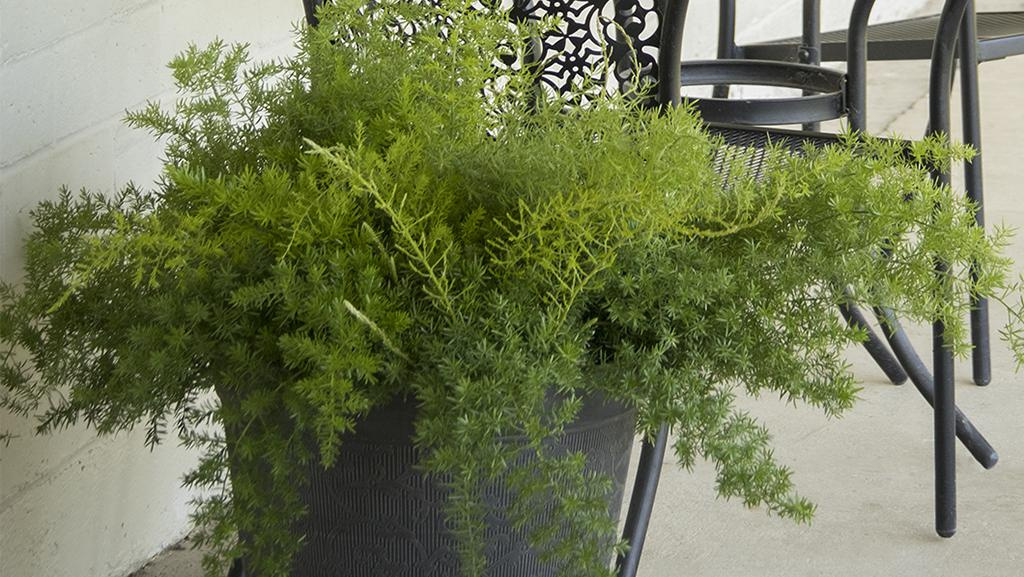

| Description | A very popular, low-growing perennial for use in hanging baskets, in cut flower arrangements, and as a groundcover. Dense, shiny green, needle-like foliage displayed on arching stems is contrasted by bright red, ornamental berries in fall. Semi-evergreen in mild winter regions; use in containers and overwinter indoors in cold winter regions. |
|---|---|
| Bloom Time | Spring |
| Deciduous/Evergreen | Evergreen |
| Special Features | Easy Care, Ornamental Berries, Fast Growing, Compact Form, Benefits Birds |
| Problems/Solutions | Coastal Exposure, Deer Resistant, Drought Tolerant |
| Growth Rate | Fast |
| Growth Habit | Clumping |
| Landscape Use | Border, Container, Houseplant, Ground Cover, Hanging Basket |
| Design Ideas | This popular mounding ground cover grows fast, its evergreen branches arching as it spreads. So frequently used that it is often overlooked until its bright red berries appear. Provide rich contrast to its needle-like leaves by planting dark-green, broad-leafed plants adjacent in a small garden. In a hanging basket or container, include a bright flowering plant or one that is taller and straighter to balance the form. |
| Flower Color | White |
| Foliage Color | Light Green |
| Companion Plants | Lantana (Lantana); Hibiscus (Hibiscus); Cordyline (Cordyline); Mandevilla (Mandevilla); Plumbago (Plumbago) |
| Care Instructions | Thrives in enriched, evenly moist, well-drained soils. Avoid harsh, hot afternoon sun exposures. Water deeply, regularly during first growing season to establish an extensive root system. Once established, prefers regular moisture, but tolerates mild drought. For a tidy appearance, remove old, faded stems. Tolerates mild frost. |
| History | This is not a fern at all but a member of the edible asparagus group. Named from the early Greek for these edible plants, there are up to 300 species in the genus, and all are native to the Old World. This species originates in the Cape of Good Hope region of South Africa. German botanist Kunth classified it. Regel named it for Italian nurseryman Karl Sprenger who did much work early on with the new introductions. |
| Lore | Though it is called a fern, this plant is not related in any way to that spore-bearing primitive group. |
Details
| Description | A very popular, low-growing perennial for use in hanging baskets, in cut flower arrangements, and as a groundcover. Dense, shiny green, needle-like foliage displayed on arching stems is contrasted by bright red, ornamental berries in fall. Semi-evergreen in mild winter regions; use in containers and overwinter indoors in cold winter regions. |
|---|---|
| Bloom Time | Spring |
| Deciduous/Evergreen | Evergreen |
| Special Features | Easy Care, Ornamental Berries, Fast Growing, Compact Form, Benefits Birds |
| Problems/Solutions | Coastal Exposure, Deer Resistant, Drought Tolerant |
| Growth Rate | Fast |
| Growth Habit | Clumping |
Style
| Landscape Use | Border, Container, Houseplant, Ground Cover, Hanging Basket |
|---|---|
| Design Ideas | This popular mounding ground cover grows fast, its evergreen branches arching as it spreads. So frequently used that it is often overlooked until its bright red berries appear. Provide rich contrast to its needle-like leaves by planting dark-green, broad-leafed plants adjacent in a small garden. In a hanging basket or container, include a bright flowering plant or one that is taller and straighter to balance the form. |
| Flower Color | White |
| Foliage Color | Light Green |
| Companion Plants | Lantana (Lantana); Hibiscus (Hibiscus); Cordyline (Cordyline); Mandevilla (Mandevilla); Plumbago (Plumbago) |
Care
| Care Instructions | Thrives in enriched, evenly moist, well-drained soils. Avoid harsh, hot afternoon sun exposures. Water deeply, regularly during first growing season to establish an extensive root system. Once established, prefers regular moisture, but tolerates mild drought. For a tidy appearance, remove old, faded stems. Tolerates mild frost. |
|---|
History
| History | This is not a fern at all but a member of the edible asparagus group. Named from the early Greek for these edible plants, there are up to 300 species in the genus, and all are native to the Old World. This species originates in the Cape of Good Hope region of South Africa. German botanist Kunth classified it. Regel named it for Italian nurseryman Karl Sprenger who did much work early on with the new introductions. |
|---|---|
| Lore | Though it is called a fern, this plant is not related in any way to that spore-bearing primitive group. |
Retailers Near You
About Us
We have been pioneers and craftsmen in the art of growing plants for 100 years. Since our founding in Southern California by Harry E. Rosedale, Sr. in 1926, we have been absolutely dedicated and obsessed with quality.
We have been pioneers and craftsmen in the art of growing plants for nearly 100 years. Since our founding in Southern California by Harry E. Rosedale, Sr. in 1926, we have been absolutely dedicated and obsessed with quality.