
You're growing in this Zip Code:
Change LocationDiscover Plants for Your Area
Sienna Sunrise® Heavenly Bamboo
Nandina domestica 'Monfar'
Pronunciation: nan-DEE-na doh-MES-ti-ka
SKU #06222
LIGHT:
Full sun, Partial sun
WATER:
Water when top 2 inches of soil is dry.
SIZE:
Slowly reaches 3 to 4 ft. tall, 2 ft. wide.

Retailers Near You
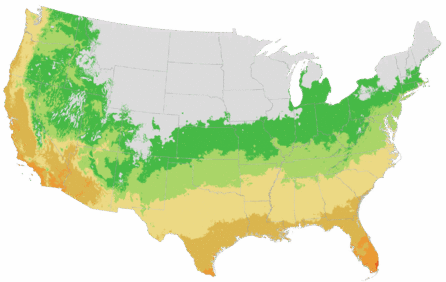

| Description | Intensely red new foliage cools to a lush green in summer. Fiery red highlights reappear in fall and winter. Occasionally produces small, white flowers in spring. The perfect shrub to use for high profile accents or nooks in architecture. Plant en masse for a dramatic, colorful landscape effect. Evergreen. |
|---|---|
| Bloom Time | Spring |
| Deciduous/Evergreen | Evergreen |
| Special Features | Dramatic Foliage Color, Easy Care, Fall Color, Waterwise, Compact Form |
| Problems/Solutions | Rabbit Resistant, Tolerates Urban Pollution |
| Growth Rate | Slow |
| Growth Habit | Rounded |
| Patent Act | Asexual reproduction of plants protected by the Plant Patent Act is prohibited during the life of the patent. |
| Landscape Use | Container, Hedge |
| Design Ideas | Use nandina to add year around color to all green shrub borders needing a pick me up. Use in its traditional bamboo-like application in Asian gardens with the lower stems pruned clean. Particularly beautiful in classic glazed Chinese ceramic pots. Ideal for pizzaz in shade garden compositions to stand out sharply against variegated or silver leaf foliage. Consummate foundation plant that won't outgrow its space. |
| Flower Color | White |
| Foliage Color | Multicolored |
| Foliage Fall Color | Red |
| Companion Plants | Kohuhu (Pittosporum); Rose (Rosa); Spreading Juniper (Juniperus); Cryptomeria (Cryptomeria); Abelia (Abelia) |
| Care Instructions | Easily grown in average, well-drained soil. Water deeply, regularly during first growing season to establish extensive root system. Once established, reduce frequency; tolerates mild drought. Apply fertilizer before new growth begins in spring. Prune back 1/3 of the stems annually to promote dense spring growth. |
| History | This new variety was introduced in 2003 by Monrovia Nursery Co., Azusa, CA. It is derived from a broadleaf shrub native to Asia often called heavenly bamboo even though it is not related to that grass. It has been avidly cultivated in Japan for centuries and sixty different named cultivars are known there. These plants were first described by Engelbert Kaempher of the Dutch East India Company in his 17th century work on Japan: Amoenitates Exoticae. The genus and species where classified by Thunberg who derived it from the Japanese name for the plant, nan-ten or nandi-na. Although the early information on origins point to Japan, the first Nandina introduced to the west in 1804, and was brought from Canton by William Kerr. |
| Lore | In the summer of 1996, Mike Farrow, owner of Holly Hill Farms in Earleville, Maryland, discovered this living gem. A ravenous beauty with a tight, compact growth habit that naturally requires minimal maintenance. An amazing array of fiery colors grace the foliage ranging from red, orange and yellow to bronzy tones, reminiscent of a beautiful sunrise. |
Details
| Description | Intensely red new foliage cools to a lush green in summer. Fiery red highlights reappear in fall and winter. Occasionally produces small, white flowers in spring. The perfect shrub to use for high profile accents or nooks in architecture. Plant en masse for a dramatic, colorful landscape effect. Evergreen. |
|---|---|
| Bloom Time | Spring |
| Deciduous/Evergreen | Evergreen |
| Special Features | Dramatic Foliage Color, Easy Care, Fall Color, Waterwise, Compact Form |
| Problems/Solutions | Rabbit Resistant, Tolerates Urban Pollution |
| Growth Rate | Slow |
| Growth Habit | Rounded |
| Patent Act | Asexual reproduction of plants protected by the Plant Patent Act is prohibited during the life of the patent. |
Style
| Landscape Use | Container, Hedge |
|---|---|
| Design Ideas | Use nandina to add year around color to all green shrub borders needing a pick me up. Use in its traditional bamboo-like application in Asian gardens with the lower stems pruned clean. Particularly beautiful in classic glazed Chinese ceramic pots. Ideal for pizzaz in shade garden compositions to stand out sharply against variegated or silver leaf foliage. Consummate foundation plant that won't outgrow its space. |
| Flower Color | White |
| Foliage Color | Multicolored |
| Foliage Fall Color | Red |
| Companion Plants | Kohuhu (Pittosporum); Rose (Rosa); Spreading Juniper (Juniperus); Cryptomeria (Cryptomeria); Abelia (Abelia) |
Care
| Care Instructions | Easily grown in average, well-drained soil. Water deeply, regularly during first growing season to establish extensive root system. Once established, reduce frequency; tolerates mild drought. Apply fertilizer before new growth begins in spring. Prune back 1/3 of the stems annually to promote dense spring growth. |
|---|
History
| History | This new variety was introduced in 2003 by Monrovia Nursery Co., Azusa, CA. It is derived from a broadleaf shrub native to Asia often called heavenly bamboo even though it is not related to that grass. It has been avidly cultivated in Japan for centuries and sixty different named cultivars are known there. These plants were first described by Engelbert Kaempher of the Dutch East India Company in his 17th century work on Japan: Amoenitates Exoticae. The genus and species where classified by Thunberg who derived it from the Japanese name for the plant, nan-ten or nandi-na. Although the early information on origins point to Japan, the first Nandina introduced to the west in 1804, and was brought from Canton by William Kerr. |
|---|---|
| Lore | In the summer of 1996, Mike Farrow, owner of Holly Hill Farms in Earleville, Maryland, discovered this living gem. A ravenous beauty with a tight, compact growth habit that naturally requires minimal maintenance. An amazing array of fiery colors grace the foliage ranging from red, orange and yellow to bronzy tones, reminiscent of a beautiful sunrise. |
Retailers Near You
About Us
We have been pioneers and craftsmen in the art of growing plants for 100 years. Since our founding in Southern California by Harry E. Rosedale, Sr. in 1926, we have been absolutely dedicated and obsessed with quality.
We have been pioneers and craftsmen in the art of growing plants for nearly 100 years. Since our founding in Southern California by Harry E. Rosedale, Sr. in 1926, we have been absolutely dedicated and obsessed with quality.